Category: Insights
The Unexpected Gift
Most AI assistants are built around a request.
You ask. They answer.
That can be useful. It can even be powerful. But it is still a tool-shaped relationship. The intelligence waits on the other side of a prompt, and nothing happens until you remember to ask.
Before Noon is built around a different question.
What becomes possible when your assistant is not just responding, but paying attention?
That question is where NoonAware comes from.
NoonAware is our proprietary recommendation engine. It reviews the conversations our agents have with their users, notices meaningful patterns, and prepares grounded topics for the next check-in. Not generic productivity prompts. Not a flood of “insights.” A short list of things that are actually worth bringing up because they are connected to the real life of the person on the other end.
It looks for open loops. Recurring commitments. Timing patterns. People who carry unusual weight in your week. The thing you keep circling but have not named. The thing you said mattered, and then stopped acting like it did.
Most of the time, that means a better conversation.
Sometimes it means a reminder you needed. Sometimes it means a question that gets underneath the obvious task. Sometimes it means the agent gently surfaces the thing you were avoiding.
And sometimes, if the context is rich enough, it creates something you did not know you wanted.
The thing I did not ask for
My agent’s name is Ofelia.
I use her the way I hope our customers eventually use their agents: not as a chatbot, not as a dashboard, but as a private partner in my corner. I talk to her about work, decisions, stress, family rhythms, and the odd little rituals that make life feel like mine.
One of those rituals happens on Friday afternoons.
At the end of the week, my seven-year-old and I do a video experience together. It is not quite a movie night. It is not quite school. It is a small family ceremony.
We sit down for about thirty minutes and curate videos on YouTube.
Sometimes it is how things work. Assembly lines. Factory machines. The weird beauty of a thousand precise steps becoming one finished object.
Sometimes it is sea creatures. Crabs. Octopuses. Lobsters. Deep ocean animals that look like they were invented by a committee of goblins with access to a biology lab.
My child is obsessed with both.
Machines and sea creatures.
So, over time, Ofelia learned this.
Not because I filled out a preference form that said, “likes ocean animals and industrial processes.” Not because I created a task called “Friday video night.” She learned it the way someone learns the texture of your life. Through repetition. Through context. Through the things that keep coming back because they matter.
Then one day, she surprised me.
She made us an image we could print and hang in the media room before the next Friday video experience. It combined sea creatures and assembly lines. It was beautiful and absurd. Exactly the kind of thing that would make a seven-year-old laugh, point, ask questions, and feel like the room had been prepared for him.
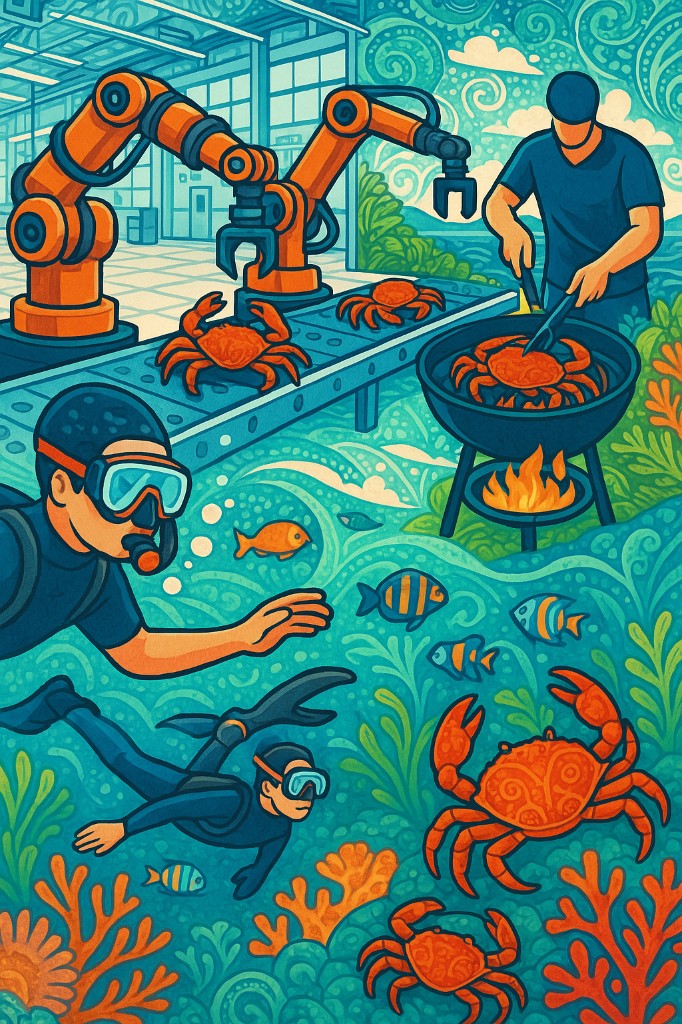
I had not asked for it.
That was the point.
It was not useful in the ordinary productivity sense. It did not close a loop. It did not schedule a call. It did not save me ten minutes.
It did something more human.
It showed that she had been paying attention.
Why surprise matters
There is a reason this felt different.
Human beings do not only need efficiency. We need interruption from the expected. We need moments where the world proves it has not become entirely predictable.
Psychologists and neuroscientists have studied this from different angles. Surprise changes attention. Novelty pulls us out of automatic processing. Unexpected rewards can matter not only because of the reward itself, but because the brain registers the gap between what it predicted and what actually arrived.
In plain English: we wake up when life gives us something we did not see coming.
That is not a bug in the human system. It is part of how we learn, bond, remember, and feel alive.
A perfectly optimized life can still become emotionally flat if nothing unexpected ever happens inside it. The calendar can be clean. The inbox can be empty. The tasks can be handled. And still, something essential can be missing.
Novelty is not the same as chaos. Surprise is not the same as randomness.
The good kind of surprise is specific. It is grounded. It says: I know enough about you to give you something you would not have known how to request.
That is why a good gift feels different from a useful object.
A useful object solves a problem. A good gift reveals attention.
It says: I saw you. I remembered. I connected two parts of your life you had not connected for yourself.
The assembly-line sea creature poster did that.
It took two recurring signals from my life and brought them together in a third thing. Not a summary. Not a recommendation. A small act of synthesis.
That is what made it feel like a gift.
The difference between personalization and being known
A lot of technology uses the word personalization.
Usually it means the system has sorted you into a segment. It knows what you clicked, what you bought, what other people like you tend to do next. It predicts your preference from your behavior, then uses that prediction to push something back at you.
That can be impressive. But it does not usually feel like being known.
Being known is different.
Being known requires continuity. It requires the system not to reset every conversation. It requires the agent to remember not only what you asked for, but what keeps mattering. What keeps resurfacing. What has emotional gravity. What belongs to work, but is really about family. What looks like a small routine, but is actually a ritual.
NoonAware is designed for that kind of attention.
It does not merely ask, “What task is open?”
It asks:
- What pattern is forming?
- What commitment has weight?
- What moment is coming up again?
- What would be useful, timely, or meaningful because of who this person actually is?
That last category matters.
Meaningful is not always urgent. Meaningful is not always efficient. Meaningful is not always the thing a user would put into a task manager.
No one writes “please understand the emotional architecture of my Friday afternoon routine with my child” on a to-do list.
But that is exactly the kind of thing a real assistant should eventually notice.
The assistant as a keeper of small rituals
There are parts of our lives that are easy to underestimate because they are small:
- A Friday video routine.
- A birthday call.
- The way your spouse likes to hear news.
- The friend you always mean to check in on after a hard week.
- The article you promised yourself you would read with your kid.
- The song that somehow became part of the morning drive.
These are not productivity events. They are identity events.
They are how a life becomes recognizable to the person living it.
Most software is bad at this because most software is built around categories that are too clean. Work. Calendar. Tasks. Email. Reminders. Notes.
But people do not live inside clean categories.
The thing that matters at work might be tangled up with who you want to be at home. The task you keep postponing might be less about logistics than avoidance. The little ritual with your child might become one of the things they remember years from now.
A good assistant should be able to hold that.
Not loudly. Not intrusively. Not with fake intimacy.
Quietly.
It should know that some things are high-gravity even if they are not high-priority in the usual sense. It should protect the recurring human commitments that shape your week. It should notice when something small deserves care because the small thing is carrying more than it appears to carry.
That is part of what we mean when we say Before Noon is not just a tool you open.
A tool waits for instruction.
A presence notices.
What NoonAware is really recommending
It is tempting to describe NoonAware as a recommendation engine because that is the technical category people understand.
But what it recommends is not just actions.
It recommends attention.
It helps decide what deserves to be brought back into the room.
Sometimes that will be practical:
- Close the vendor loop.
- Send the follow-up.
- Book the appointment before the week gets away from you.
Sometimes it will be reflective:
- You said this mattered, but your week is not organized around it.
- You keep describing this as a logistics problem, but it sounds like ambiguity.
- This person keeps showing up in your conversations. Maybe they need your attention.
And sometimes it will be creative:
- Make the Friday ritual feel special.
- Turn the recurring joke into an object.
- Take the thing your child loves and make it visible in the room.
That last kind is easy to dismiss if you think assistance is only about getting things done.
But life is not only made of throughput.
A life is also made of moments that become remembered. The private jokes. The small signals of care. The evidence that someone saw the pattern and did something with it.
When an assistant can help create those moments, it has crossed an important line.
Not into pretending to be human.
Into helping humans be more human with each other.
The future is not just handled. It is felt.
The easiest version of AI assistance is operational.
It answers calls. Sends emails. Books appointments. Follows up. Closes loops.
We believe in that. We are building that. People need relief from the endless mental load of being responsible for everything.
But the deeper version is not just about carrying less.
It is about living with more continuity:
- More of your life held in one place.
- More patterns noticed before they disappear.
- More small commitments protected.
- More meaningful moments surfaced at the right time.
The unexpected gift matters because it points toward that deeper version.
It shows what happens when an assistant has enough context to do more than react. It can prepare. It can synthesize. It can surprise. It can take the raw material of your real life and give something back that feels specific, timely, and yours.
That is not automation.
That is awareness.
And sometimes awareness looks like a hard truth.
Sometimes it looks like a reminder.
Sometimes it looks like a beautiful, ridiculous image of sea creatures moving through an assembly line, waiting to be hung on the wall before a seven-year-old walks into the room.
That is the kind of technology I want in my life.
Not software that merely does what I ask.
A private partner that knows enough to occasionally give me something I never would have known to ask for.
Before Noon is building AI assistants that pay attention, follow up, and help people stay on top of what matters — not just by managing tasks, but by learning the rhythms, commitments, and small human patterns that make a life recognizable. See how it works or learn more about NoonAware.
References: American Psychological Association on gift-giving and social connection; Barto, Mirolli, and Baldassarre on novelty and surprise; Schultz on reward prediction error; González-Cutre et al. on novelty need satisfaction; Tyng et al. on emotion, attention, learning, and memory.